
K-Town, Explained
Koreatown occupies a concentrated stretch of West 32nd Street between Fifth Avenue and Broadway — officially dubbed Korea Way — with spillover onto the surrounding blocks from roughly 31st to 36th Street between Fifth and Sixth Avenues. On a map it looks impossibly small. In person it feels like a city within a city, because the neighborhood builds upward rather than outward. Restaurants, karaoke rooms, spas, and nightclubs stack vertically inside Midtown office buildings, many of them operating well past midnight and some never closing at all.
The neon starts around dusk. Korean signage lights up alongside the Empire State Building, which looms directly to the east on 34th Street. The sidewalks fill with a mix that’s distinctly Koreatown: office workers heading to after-work barbecue, tourists following food blogs to their first bibimbap, Korean-American families maintaining traditions, and late-night crowds drifting between karaoke and soju bars. The energy peaks around 10 PM on a Friday and doesn’t subside until 3 AM.
This is not a quiet residential enclave. Koreatown is a commercial and cultural corridor that happens to sit in one of Manhattan’s best-connected transit hubs. Living here means accepting the noise and the crowds in exchange for something no other Midtown neighborhood offers: a genuine, self-sustaining cultural ecosystem where you can get sullengtang at 2 AM, a body scrub at midnight, and a private karaoke room at any hour. The neighborhood runs on its own clock, and that clock doesn’t care about your schedule.
Madison Square Garden is two blocks west. The Empire State Building is one block east. Herald Square and Macy’s are at your doorstep. Penn Station is a five-minute walk. And yet none of those landmarks define daily life here the way the smell of Korean barbecue wafting up from a second-floor restaurant on 32nd Street does.
If Koreatown Were a PersonEarly 30s, works in finance or tech but lives for the after-hours. Speaks two languages fluently and code-switches without thinking. Knows which floor of which building has the best galbi-jjim, and doesn’t bother explaining it to people who haven’t been. Owns a $400 skincare routine and considers it a necessity, not a luxury. Takes out-of-town friends to Hyun for the Wagyu omakase and to a 32nd Street basement karaoke spot for the real evening. Has never once described the neighborhood as “up and coming” because it arrived decades ago — you just weren’t paying attention.
Section 02Koreatown Real Estate: The Numbers
Koreatown sits within the broader Midtown South real estate market, and the pricing reflects its position at the intersection of convenience and character. The housing stock is a mix of prewar co-ops, postwar rentals, and a growing number of condo conversions and new developments that have reshaped the area over the past decade. If you’re considering the true cost of condo ownership in NYC, this neighborhood offers a compelling case study in value relative to location.
$1.1MMedian Sale Price 72Avg Days on Market $1,350Median $/Sq FtThe Midtown South market in early 2026 is bifurcated in familiar ways. Manhattan’s overall median sale price hit $1.4M in January 2026, up 14.8% year-over-year — but Koreatown’s immediate surroundings remain slightly below that benchmark, making it one of the few Midtown locations where entry-level buyers can still find a foothold. Condos in the area average $1,350 per square foot, compared to $2,000+ in nearby NoMad and Flatiron. Co-ops run 20–30% less per square foot, with studios starting under $500K and one-bedrooms in the $650K–$900K range.
| Property Type | Median Price | YoY Change | Avg $/SF |
|---|---|---|---|
| Condo | $1.4M | +12% | $1,500 |
| Co-op | $680K | -5% | $950 |
| New Development | $2.2M+ | Varies | $1,800+ |
Rent vs. Buy: The Lifestyle Math
A one-bedroom rental in Koreatown averages $4,200–$4,800 per month. Two-bedrooms jump to $7,500–$8,500. That’s $50K–$102K per year in rent. A comparable one-bedroom condo might cost $750K–$1M to purchase, with monthly carrying costs (mortgage, common charges, taxes) in the $4,500–$5,500 range. The math tips toward buying if you’re staying more than four years — and the rental demand in this pocket of Midtown means your exit strategy is built in. Koreatown’s walkability score of 99 out of 100 makes it perpetually attractive to renters, which protects your investment on the way out.
For international buyers exploring this market, I’ve written about how to buy NYC real estate remotely and the nuances of cross-border financing that apply here.
Free ConsultationConsidering Koreatown?
Let’s talk about what’s available and what fits your lifestyle.
Section 03Where I’d Live
If I were buying in the Koreatown area right now, these are the two buildings I’d focus on. One is squarely in K-Town’s core; the other is a short walk south but represents the best new development value in the immediate orbit. Both benefit from Koreatown’s energy without sacrificing the finishes and amenities serious buyers expect.

Madison House — 15 East 30th Street
1-4 BD | 1-3 BA | 1,000-4,000+ SF | Condo
$2.5M – $15M+ View Full Profile →Two blocks south of Koreatown’s core, Madison House is NoMad’s tallest residential tower — a 62-story landmark rising above Madison Square Park. The building features floor-to-ceiling windows in every residence, private terraces on select units, and interiors by Gachot Studios that layer warm woods, natural stone, and bronze accents. Amenities include a 75-foot indoor pool, private dining room, golf simulator, children’s playroom, and a rooftop observatory with 360-degree views. This is the building for someone who wants to walk to K-Town for dinner and come home to something extraordinary. I’ve written a full profile of Madison House.

The Bryant — 16 West 40th Street
57 Residences | Luxury Condo | David Chipperfield Architects
Luxury Condos View Building on StreetEasy →Designed by Pritzker Prize-winning architect David Chipperfield, The Bryant is a 33-story luxury condominium tower at 16 West 40th Street, directly across from Bryant Park. The building’s distinctive facade of angled glass and white precast concrete creates a striking presence on the Midtown skyline. With just 57 residences, it offers an intimate scale rarely found in this part of Manhattan. Interiors feature floor-to-ceiling windows, wide-plank oak floors, and Bulthaup kitchens. Amenities include a 24-hour attended lobby, fitness center, residents’ lounge, and a rooftop terrace overlooking Bryant Park. The location puts you steps from the park’s year-round programming and a short walk north from K-Town’s dining scene. Website: thebryantnyc.com.
Section 04Where to Eat
My favorite restaurant near Koreatown: Hyun. Melt-in-your-mouth. Hands down the best wagyu experience in the city and it's even all you can eat. The signature $159 Hyun-makase features 12 pieces of A5 Wagyu, each prepared with a different Korean-inspired technique that showcases the depth and complexity of premium beef. The space is intimate, the service meticulous, and the entire experience operates at a level that justifies the price without fanfare.
 Korea Way — the neon-lit heart of Manhattan’s Koreatown on 32nd Street
My go-to coffee spot: Tous les Jours. This French-Asian bakery at 31 West 32nd Street is a Koreatown institution with over 300 items rotating daily — from milk bread and red bean pastries to croissants and matcha lattes. Not only does it have the most seating, this is where I stop by if my wife is craving Korean pastries.
Three restaurants worth knowing:
Joo Ok — Perched on the 16th floor at 22 West 32nd Street, Joo Ok is a Michelin-starred jewel presided over by Chef Chang-Ho Shin. The 12-course tasting menu is contemporary Korean at its most refined — dishes that honor tradition while pushing into territory that feels entirely new. The elevation above K-Town’s neon streets adds a cinematic quality to the experience.
Atomix — Two Michelin stars and a spot on the World’s 50 Best. Husband-and-wife team Junghyun and Ellia Park serve a multi-course Korean tasting menu ($325) that tells the story of Korea through each dish. A one-of-a-kind Korean fine-dining experience and a trailblazer in the fine-dining scene.
Yoon Haeundae Galbi — The galbi here is the real thing — better than most places in Seoul even. Marinated short ribs grilled tableside with a precision and flavor profile that traces directly back to the original Haeundae beach location in Busan. No frills, no fusion, just decades of technique applied to premium beef. This is the barbecue spot that Korean expats bring their parents to.
Section 05Shopping & Nightlife
Koreatown’s retail operates on a vertical model that mirrors Seoul. Walk into what looks like a nondescript office building on 32nd Street and you’ll find floors of Korean beauty shops, bookstores, and lifestyle brands stacked above street-level restaurants. The Face Shop and Innisfree carry Korean skincare products that haven’t made it to Sephora yet. Koryo Books is one of the last Korean-language bookshops in Manhattan, carrying everything from K-pop magazines to Korean literature in translation.
For fashion, Herald Square puts you steps from Macy’s flagship store and the surrounding retail corridor on 34th Street. But the more interesting shopping is south in NoMad and the Flatiron District, where boutiques line Broadway and Fifth Avenue below 30th Street.
 Koreatown — where Manhattan’s grid meets Seoul’s vertical culture
Nightlife in K-Town is sui generis. Karaoke K and Gagopa Karaoke on 32nd Street offer private rooms by the hour with Korean songbook catalogs that run thousands of pages deep. Maru Karaoke Lounge is the upscale option — an elegant space that begins as a lounge and evolves into a full nightlife experience. The rooms fill with birthday parties, after-work groups, and couples on dates who have no intention of leaving before 2 AM.
Pocha 32 captures the pojangmacha (Korean street tent bar) experience in a basement space — soju towers, corn cheese, and the kind of communal energy that makes strangers into friends by the second round. It’s chaotic, loud, and exactly right.
Exclusive to Koreatown24-hour Korean restaurants in Midtown Manhattan — Koreatown is the only neighborhood in Manhattan where you can sit down to a full Korean meal — galbitang, kimchi jjigae, dolsot bibimbap — at 4 AM on a Tuesday without a hint of irony. Restaurants like Wonjo and Kang Ho Dong Baekjeong simply never close. No other Midtown neighborhood operates on this schedule. Let's not foret the Karaoke
Vertical cultural stacking — Koreatown is the only place in New York where a single building can contain a Korean barbecue restaurant on the second floor, a noraebang on the third, a spa on the fourth, and a beauty supply shop on the fifth. This Seoul-style vertical urbanism exists nowhere else in the city at this concentration.
Section 06Where to Stay When You Visit
If you’re thinking about buying near Koreatown, stay in the neighborhood first. Walk the blocks at night. Eat on 32nd Street at 11 PM. See if the energy suits you. This hotel puts you in the right position to find out.
 Koreatown from above — the Empire State Building’s backyard
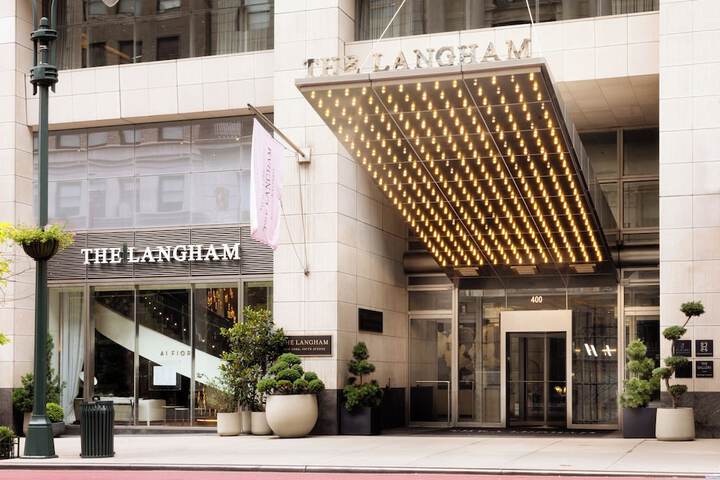
The Langham, New York, Fifth Avenue — Rising 60 stories above Fifth Avenue in a Gwathmey Siegel-designed tower, The Langham is Koreatown’s closest true luxury hotel. The 234 rooms feature premium bedding, pillow menus, and views of the Empire State Building that are so close they feel cinematic. Ai Fiori, the hotel’s Michelin-starred restaurant, serves French-Italian cuisine on the second floor. The spa, indoor pool, and 24-hour fitness center round out the amenities. Stay here and you’re steps from 32nd Street without sacrificing anything in comfort.
✉The Advice I Give My Clients — In Your Inbox
A weekly email with the insights, advice, and perspective I share with my own clients — now in your inbox.
Section 07Schools & Family Life
5/10Raising Kids ScoreKoreatown is not where most families with young children land — and that’s reflected in the housing stock, which skews heavily toward studios and one-bedrooms. But families do live here, and the ones who do tend to value the neighborhood’s cultural richness and Midtown convenience over the quiet, tree-lined blocks of the Upper West Side. The challenge is space: three-bedroom apartments are rare and expensive, and the streets around 32nd Street are loud after dark.
Public schools: PS 116 Mary Lindley Murray is the zoned elementary school on East 33rd Street, serving pre-K through 5th grade with a diverse student body that reflects the neighborhood’s demographics. For middle and high school, the Murray Hill/Kips Bay corridor offers several options, and the specialized high school exam opens doors to Stuyvesant, Bronx Science, and Brooklyn Tech. The Gramercy neighborhood guide covers nearby school options in more detail.
Private schools: Trevor Day School (K-12) is on the Upper East Side but accessible by subway. Columbia Grammar & Preparatory School is a strong pre-K through 12 option on the Upper West Side, also a subway ride away. Closer to home, Avenues: The World School in Chelsea offers a progressive, globally minded education from nursery through 12th grade. For Korean-speaking families, several after-school Korean language programs operate within Koreatown itself.
Family-friendly amenities include Madison Square Park’s playgrounds (a 10-minute walk south), the 14th Street Y, and Hudson River Park’s sports fields accessible via crosstown bus or a longer walk west.
Section 08History & Architecture
Koreatown’s story is one of reinvention. The blocks around 32nd Street were historically part of Manhattan’s Garment District — a commercial zone of loft buildings, wholesalers, and the textile trade that defined Midtown’s economy through the mid-20th century. As the garment industry declined after World War II, the area entered a transitional period that set the stage for what came next.
Korean immigration to New York accelerated after the Immigration and Nationality Act of 1965 liberalized entry from Asia. During the 1970s and 1980s, Korean-owned businesses clustered in the rectangular area from 24th to 34th Streets between Fifth and Sixth Avenues — initially wholesalers and importers, then retail and food. The opening of a Korean bookstore and a handful of restaurants on 32nd Street in the early 1980s created the nucleus of what would become Koreatown. With their success, a second wave of Korean businesses took root: barbecue restaurants, karaoke bars, beauty shops, and branches of Korean banking conglomerates.
The architecture tells this layered story. The dominant buildings are early 20th-century commercial lofts and Art Deco office towers from the 1920s and 1930s, many of which retain their original facades while housing entirely new interiors. The Empire State Building (1931), the neighborhood’s most famous structure, represents the apex of Art Deco design in New York. Along 32nd Street, the exteriors are almost secondary — the real architecture is inside, where ground-floor lobbies open into vertical mazes of restaurants, karaoke rooms, and businesses that transform Midtown commercial buildings into cultural infrastructure.
Today, Koreatown encompasses over 150 businesses and has been described as the “Korean Times Square.” The neighborhood earned official recognition when the city designated 32nd Street between Fifth and Sixth Avenues as “Korea Way” — the bilingual street signs in English and Korean are among the few of their kind in Manhattan.
Section 09Parks & Outdoor Spaces
Greeley Square & Herald Square are the neighborhood’s front yard. These twin triangular parks sit at the intersection of Broadway and Sixth Avenue at 33rd–34th Streets, directly adjacent to Koreatown. The 2009 “Broadway Boulevard” pedestrian project more than doubled the usable space, adding tables, chairs, planters, and seasonal programming including free fitness classes, salsa dancing, and outdoor performances. On a warm afternoon, the tables fill with office workers, tourists, and K-Town regulars eating takeout from 32nd Street.
Madison Square Park is a 10-minute walk south and a world apart in atmosphere. This 6.2-acre park between 23rd and 26th Streets is one of Manhattan’s most beautiful green spaces — landscaped with mature trees, public art installations, a dog run, and the original Shake Shack. Mornings here are quiet enough for a run or a bench-and-book session. The park was designated a public space in 1686 and became part of the New York Parks system in 1870 — one of the oldest parks in the city. If you live in Koreatown, this becomes your weekend retreat.
Bryant Park at 42nd Street is a 10-minute walk north and offers seasonal attractions — the winter village and ice rink in December, outdoor movies in summer, and year-round café seating surrounded by London plane trees. Hudson River Park is accessible via 34th Street crosstown, connecting you to the waterfront greenway for running, cycling, and sunset views.
Section 10Getting Around
Koreatown sits at the nexus of Manhattan’s transit infrastructure. No neighborhood in the city has better subway access relative to its size. The hub is 34th Street–Herald Square, where the B, D, F, M, N, Q, R, and W lines converge — one of the busiest and most connected stations in the system. From here you’re 10 minutes to Times Square, 15 to the Financial District, 20 to the Upper East or Upper West Side, and one stop from Bryant Park.
34th Street–Penn Station is a five-minute walk west, adding the 1, 2, 3, A, C, and E lines to your options. Penn Station itself provides Amtrak, NJ Transit, and the Long Island Rail Road — making Koreatown one of the few Manhattan neighborhoods where you can get to the Hamptons, New Jersey, or Washington, D.C. without a car or a complicated transfer.
Most K-Town residents walk for daily errands. The neighborhood’s 99-out-of-100 walkability score is not an exaggeration — groceries, pharmacies, dry cleaning, and dining are all within a few blocks. Citi Bike stations dot the area for crosstown trips. For airports, an Uber to LaGuardia runs 20–30 minutes; JFK is 45–60 via the LIRR to Jamaica and the AirTrain.
Key transit stops near Koreatown. Subway lines: B, D, F, M, N, Q, R, W, 1, 2, 3, A, C, E, 6. Plus Amtrak, NJ Transit, and LIRR at Penn Station.
Section 11Is Koreatown Right for You?
You’ll love it if: You want to live in the center of Manhattan with immediate access to every subway line, eat world-class Korean food on your doorstep, and don’t mind that your neighborhood doubles as a destination for the rest of the city. You value cultural authenticity over curated aesthetics. You work in Midtown and want a commute measured in minutes, not stops. You appreciate that your neighborhood never sleeps — and neither do you, at least not on weekends. If you’re exploring off-market buying opportunities in NYC, the K-Town area occasionally surfaces deals that never hit the open market.
You might want to look elsewhere if: You need quiet residential streets and tree-lined blocks. Koreatown is commercial at its core, and the noise reflects that — especially on weekend nights. If you want new construction with a full-service amenity suite at a lower price per square foot, consider Midtown West or the SoHo corridor. If schools are a top priority, the Upper East Side or Gramercy offer stronger options within the public school system.
Koreatown rewards people who want energy, culture, and convenience in equal measure — and who understand that the best parts of this neighborhood are found behind unmarked doors and above street level. If that sounds like you, let’s talk.
FAQFrequently Asked Questions
Is Koreatown a good place to live?
Yes — if you value Midtown convenience, world-class dining, and a neighborhood with genuine cultural depth that operates around the clock. It’s one of the best-connected locations in Manhattan, with a walkability score of 99/100 and subway access to virtually every line. The trade-off is noise: this is a commercial and nightlife corridor, not a quiet residential enclave. Median sale prices hover around $1.1M, making it one of the more accessible Midtown neighborhoods.
What is the average apartment price in Koreatown?
As of early 2026, the median sale price in the Koreatown area is approximately $1.1M. Condos average around $1,350 per square foot, while co-ops run $950 per square foot. Studios start under $500K, one-bedrooms range from $650K to $1M, and two-bedrooms in newer buildings list from $1.4M to $2.5M. New developments nearby, like Madison House, push into the $2.5M–$15M range.
Is Koreatown safe?
Koreatown is a busy, well-trafficked Midtown neighborhood with high foot traffic at all hours, which provides a natural layer of safety. Like any Midtown commercial district, petty crime exists, but violent crime is relatively uncommon. The 24-hour nature of the neighborhood means the streets are rarely empty, and the proximity to major transit hubs and tourist destinations (Herald Square, the Empire State Building) ensures a consistent police presence.
What subway lines serve Koreatown?
Koreatown is served by the B, D, F, M, N, Q, R, and W lines at 34th Street–Herald Square, the 1, 2, and 3 lines at 34th Street–Penn Station, and the A, C, and E lines at 34th Street (Eighth Avenue). The 6 line is available at 33rd Street on Park Avenue. Penn Station adds Amtrak, NJ Transit, and the LIRR. It is among the best-connected neighborhoods in all of New York City.
ARPWondering If We’re the Right Fit?
Every client and agent relationship starts with chemistry. Take our quick compatibility quiz to see if we’re the right team for your search.
Take the Quizor email me at anthony.park@corcoran.com