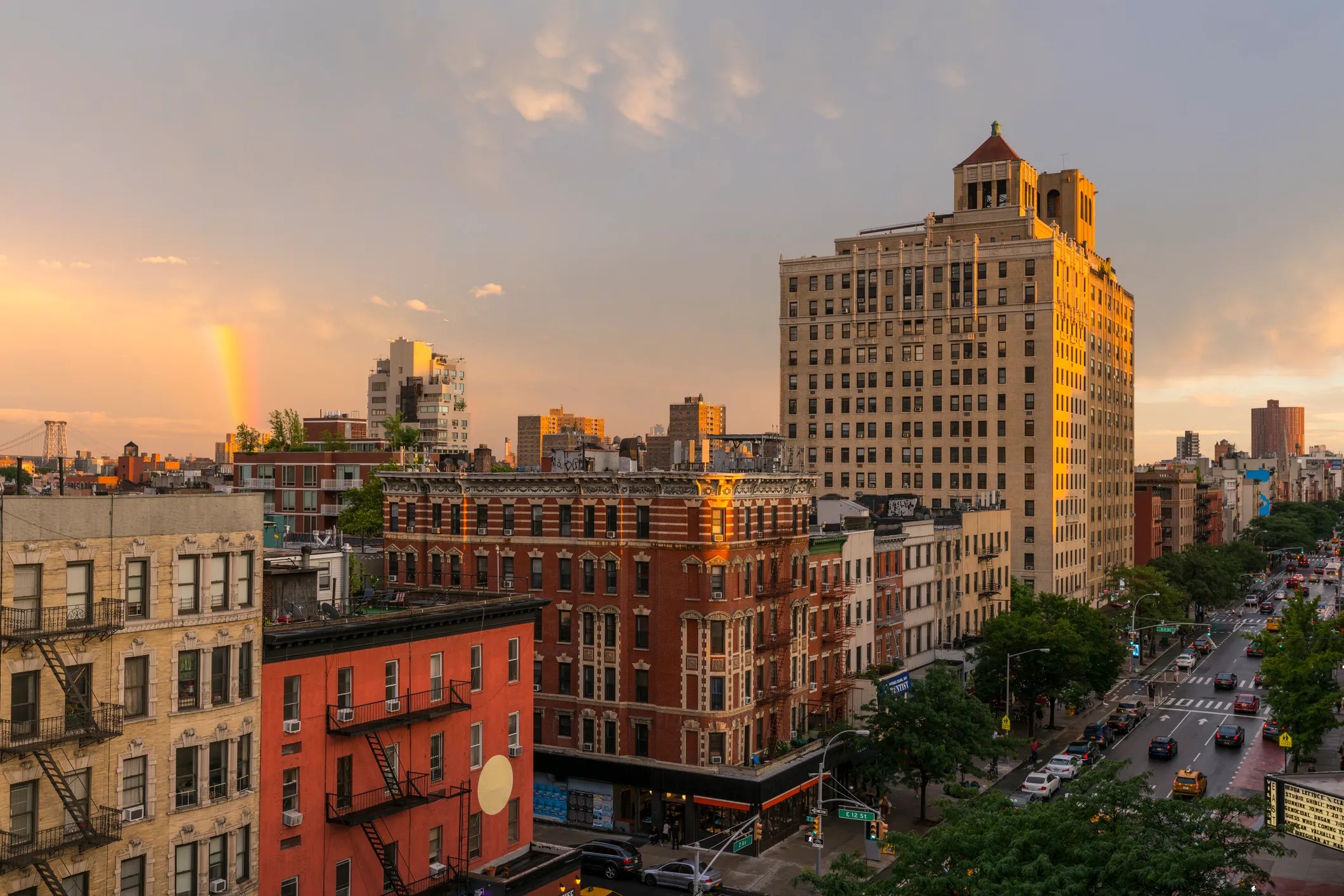
The East Village, Explained
The East Village spans from Broadway east to the East River, and from Houston Street north to 14th Street. It is, on paper, a modest slice of Manhattan. In practice, it is one of the most layered, restless, and culturally significant neighborhoods in the city — a place where a $7 million penthouse can sit three blocks from a punk dive bar that hasn’t changed its beer list since 1982.
The neighborhood grew up as immigrant territory — German, Irish, Ukrainian, Puerto Rican — and that DNA is still legible in the streetscape. Veselka still serves borscht on Second Avenue. The mosaic-covered storefronts of St. Marks Place still pulse with foot traffic after midnight. And the community gardens that sprouted on abandoned lots in the 1970s are now some of the most fiercely protected green spaces in the city, maintained by residents who remember when this neighborhood was written off entirely.
Today the East Village is a study in productive contradiction. The blocks around Tompkins Square Park have gentrified considerably — boutique coffee shops, natural wine bars, and artisanal ice cream sit beside bodegas and 99-cent pizza. Alphabet City (Avenues A through D) retains a grittier edge, with more affordable walk-ups and a nightlife scene that skews younger and louder. The western blocks near Astor Place feel almost like a different neighborhood entirely — cleaner, quieter, with newer condo developments that nod to NoHo’s polish. Between all of it, NYU students, artists, tech workers, and young families negotiate a shared streetscape that somehow still works.
If the East Village Were a PersonEarly 30s, household income anywhere from $80K to $800K depending on which block you land on. Works in something creative — or works in finance but wears vintage. Has a tattoo they got at whatever parlor was on St. Marks in 2019. Eats at the counter at Veselka at 1 AM after a show and considers this a spiritual practice. Knows which community garden on Avenue B has the best tomatoes. Owns a bike, does not own a car, and finds the concept of a doorman building philosophically suspect — unless they’re looking at 347 Bowery.
East Village Real Estate: The Numbers
The East Village occupies a unique position in the Manhattan market: expensive enough to be inaccessible to most New Yorkers, but still significantly cheaper per square foot than Greenwich Village, the West Village, or SoHo next door. The housing stock is roughly 60% co-ops and 40% condos, with most buildings being prewar walk-ups of five or six stories. Elevators are the exception, not the rule — and that shapes everything from pricing to who lives here. If you’re weighing the structural differences, our guide to co-ops vs. condos is a good place to start.
$1.5MMedian CondoPrice 90Avg Days on
Market $1,630Median
$/Sq Ft
As of early 2026, the East Village market tells a split story. The median condo price surged to $1.5 million, up over 50% year-over-year — driven partly by new development closings at buildings like Steiner East Village at 438 East 12th Street. Co-ops, meanwhile, landed at a $942K median, up 45% YoY, reflecting the neighborhood’s strong demand for more affordable ownership options. Days on market ticked up to 90 from 80, suggesting buyers are being more selective even as prices climb. The median price per square foot is $1,630, making this neighborhood a relative value play compared to the West Village’s $2,000+ per square foot.
| Property Type | Median Price | YoY Change | Avg $/SF |
|---|---|---|---|
| Condo | $1.5M | +51.9% | $1,630 |
| Co-op | $942K | +45% | $1,100 |
| Townhouse | $6M–$12M+ | Varies | $1,500+ |
Rent vs. Buy: The Lifestyle Math
A two-bedroom rental in the East Village runs $5,000–$7,500 per month depending on the building and the block. That’s $60K–$90K per year in rent with zero equity. A comparable two-bedroom co-op might cost $1.2M–$1.6M to purchase, with monthly carrying costs (mortgage, maintenance, taxes) in the $6,500–$8,500 range. The break-even horizon is roughly six years, which is consistent with most of Manhattan — and if you’re curious about the full cost picture, our guide to the true cost of owning a condo in NYC lays it out.
The East Village is one of those neighborhoods where the rental market stays tight because demand outpaces supply consistently. If you buy here and later decide to relocate, expect strong rental demand for your unit — especially for one- and two-bedrooms near Tompkins Square Park or along the First Avenue corridor.
Considering the East Village?
Let’s talk about what’s available and what fits your lifestyle.
Start a ConversationWhere I’d Live
If I were buying in the East Village right now, these are the two buildings I’d focus on. Both are boutique condominiums with genuine architectural distinction and the kind of finishes that justify their price points. They represent the best of what this market offers.

347 Bowery
5 Units | 13 Stories | Condo | Built 2017
$5M – $10M+
View Building on StreetEasy →A boutique condominium by Selldorf Architects comprising five duplex and triplex residences ranging from 2,100 to 4,000 square feet each. Residents enter through a gated mews courtyard into an attended lobby, and the building features a third-floor viewing garden. Sitting directly across from the Bowery Hotel at the crossroads of NoHo and the East Village, 347 Bowery is one of the most architecturally distinguished addresses on the strip.

Eighty East Tenth — 80 East 10th Street
1-5 BD | 1-4 BA | 12 Units | 10 Stories | Condo | Built 2017
$4.15M – $8.25M
View Building on StreetEasy →A ten-story boutique condominium by NAVA with just 12 residences averaging 2,000 square feet each. The stacked-block architecture is among the most distinctive in the neighborhood. Units feature gas fireplaces, terraces, triple-glazed windows, and in-unit washers and dryers. Building amenities include an attended lobby, a private garden with a commissioned sculpture, a fitness center, and a landscaped rooftop terrace with skyline views. Located at the corner of East 10th and Fourth Avenue, four blocks from Union Square — and one of the best new developments in NYC.
Where to Eat
My favorite restaurant in the East Village: Secchu Yokota. A kaiseki-inspired tempura omakase. You might think that's too much fried food, but you'd be completely wrong. The batter is light and not greasy. The multi-course menu is intimate, deliberate, and unlike anything else in the East Village. Don't don't be surprised when the superb quality of food doesn't match the casual interior .
 St. Marks Place — the cultural artery of the East Village since the 1960s
My go-to coffee spot: Kona Coffee . A neighborhood staple that delivers on the fundamentals — excellent espresso, solid pour-overs, and the kind of unpretentious atmosphere that makes you want to become a regular. The cortado is the move, and the window seats are prime East Village people-watching territory.
Three restaurants worth knowing:
Sushi Mumi — An omakase counter on St Marks place where the chef serves authentic edomae omakase. The 12-seat format makes every meal feel personal. Chef Lin, previously at Sushi Ginza Onodera delivers the best omakase in the area.
Ariari — Korean comfort food elevated — the tteokbokki and fried chicken are the signatures, and the East Village crowd packs it nightly. The menu is deceptively simple, but the execution is sharp and the flavors are bold. This is the kind of neighborhood restaurant that earns its following one plate at a time.
Bowery Meat Company — The highest-rated restaurant in the East Village on most platforms, and deservedly so. Dry-aged steaks, an excellent raw bar, and a whiskey list that could keep you occupied for a month. The 45-day dry-aged ribeye is the move. Dark wood, leather booths, and a crowd that appreciates substance over scene. 9 East 1st Street.
Shopping & Nightlife
St. Marks Place between Second and Third Avenues is still the commercial heart — a dense, noisy stretch of vintage shops, ramen counters, tattoo parlors, and independent record stores that somehow survives the rent cycle every year. Walk east on St. Marks toward Tompkins Square and the energy shifts: more neighborhood-oriented, fewer tourists, better coffee. Trash and Vaudeville, the legendary punk fashion shop, has been on the block since 1975 and is an East Village institution.
For books, The Strand is technically Union Square but sits right on the East Village border at 12th and Broadway — 18 miles of used and new books across four floors. East Village Books on St. Marks Place is smaller, scrappier, and the kind of place where you find a first-edition paperback for $3 and feel like you’ve won something.
 Tompkins Square Park — the neighborhood’s living room since 1834
Nightlife is where the East Village still separates itself from every other neighborhood in Manhattan. CBGB is gone, but the spirit lives on at venues like Nublu on Avenue C (live jazz, world music, a crowd that dances) and Berlin under Avenue A (underground parties, DJs, no pretense). Please Don’t Tell (PDT), accessed through the phone booth inside Crif Dogs on St. Marks, remains one of the city’s most celebrated speakeasies. And the dive bars — Manitoba’s, 7B (the Horseshoe Bar), Lucy’s — are the reason people fall in love with this neighborhood in the first place.
Exclusive to the East VillageThe budget omakase capital of Manhattan. No other neighborhood in the city concentrates this many high-quality, affordable omakase counters in such a small radius. Sushi Muni, Secchu Yokota, Sushi on Me, Ito, and a rotating cast of chef-driven counters on and around East 10th through 14th Streets offer multi-course omakase experiences for $80–$150 that would cost $300+ in Midtown. The format is intimate — 8 to 14 seats, direct interaction with the chef, fish sourced from Toyosu and local markets — and the quality rivals restaurants charging three times the price. For anyone serious about sushi, the East Village is where you eat twice a week instead of once a month.
Where to Stay When You Visit
If you’re thinking about buying in the East Village, stay for a long weekend first. Walk the blocks between Avenues A and C at midnight. Sit in Tompkins Square Park on a Saturday morning. Buy groceries at the Essex Street Market. These two hotels put you in the right position to experience the neighborhood as a resident, not a tourist.
 The Physical Graffiti building on St. Marks Place — Led Zeppelin immortalized this East Village facade
PUBLIC, an Ian Schrager Hotel — Ian Schrager’s luxury-for-all concept at 215 Chrystie Street — 367 rooms with floor-to-ceiling windows, a rooftop bar, and the kind of minimalist design that lets the neighborhood do the talking. Steps from the Bowery and the heart of the East Village, PUBLIC is the rare hotel that feels like it belongs here rather than being imposed on the block. If you’re visiting the Greenwich Village side of things too, the location works beautifully. 215 Chrystie Street.
The Bowery Hotel — On the Bowery at East 1st Street, this is the East Village hotel. 135 loft-style rooms with oversized factory windows, worn leather furniture, dark wood paneling, and the kind of patina that cannot be manufactured. The ground-floor bar and restaurant channel old-world glamour without trying too hard, and the lobby fireplace is reason enough to visit on a winter evening. The views from upper floors — water towers, brick facades, the Manhattan skyline — remind you exactly where you are. 335 Bowery.
The Advice I Give My Clients — In Your Inbox
A weekly email with the insights, advice, and perspective I share with my own clients — now in your inbox.
Schools & Family Life
6/10Raising Kids ScoreThe East Village is not the first neighborhood people think of for families, but it works better than its reputation suggests. Tompkins Square Park has two excellent playgrounds. The community gardens on Avenues B and C function as informal neighborhood gathering spaces. And the walkability means older kids gain independence earlier here than almost anywhere else in the city. The constraint is space — three-bedroom apartments are rare and expensive in this market, and most buildings are walkups without the stroller-friendly amenities of newer developments.
Public schools: The East Village Community School (M315) is the standout — 67% of students score at or above proficient in math, 52% in reading, both above the district average. It earned a U.S. News Best Elementary Schools designation. PS 63 (The Star Academy) is another option, though test scores run lower. For middle and high school, students feed into some of the city’s strong District 1 options, and specialized high school admissions remain accessible from this neighborhood.
Private schools: Grace Church School (pre-K through 8) on East 10th Street is the premier private option in the immediate neighborhood — Episcopalian, small class sizes, and deeply embedded in the community. For high school, Stuyvesant is accessible via the L train, and both Friends Seminary (16th Street) and LREI in Greenwich Village are within easy reach. If you’re purchasing remotely as an international buyer, the school landscape is one of the first things to research.
Family amenities include the 14th Street Y, the East River Park (undergoing a major renovation through the East Side Coastal Resiliency project), and a network of local playgrounds and community centers that make daily life with kids more manageable than the nightlife reputation might suggest.
History & Architecture
The East Village was not always its own neighborhood. Until the 1960s, it was considered the northern end of the Lower East Side. The rebranding — driven partly by real estate interests and partly by the bohemian culture that was settling in — stuck, and the East Village became the name for a place that had already been reinventing itself for over a century.
In the 1840s through 1880s, German immigrants transformed the area into Kleindeutschland — Little Germany — the largest German-speaking community in the United States. The grand beer halls, social clubs, and Romanesque church buildings from that era still mark the streetscape, particularly around Tompkins Square Park. After the General Slocum steamship disaster of 1904, which killed over a thousand residents, the German community dispersed and waves of Eastern European, Italian, and Puerto Rican families moved in.
The architecture is predominantly Old Law and New Law tenement buildings from the 1880s–1910s — five- and six-story walk-ups with decorative cornices, fire escapes, and narrow floor plans designed for density. These buildings define the East Village skyline. Scattered among them are Federal-style rowhouses from the 1830s (particularly along St. Marks Place and Stuyvesant Street), Italianate brownstones from the 1860s, and a handful of modernist interventions. The Renwick Triangle at Stuyvesant and East 10th Street — a group of 16 Anglo-Italianate houses designed by James Renwick Jr. in 1861 — is among the most architecturally significant blocks in the neighborhood.
The counterculture arrived in the 1950s and 1960s: Beat poets, folk musicians, and eventually the punk scene that erupted at CBGB in the mid-1970s. The Tompkins Square Riot of 1988 — a clash between police and residents over the enforcement of a curfew in the park — became a turning point in the neighborhood’s relationship with gentrification. That tension is still alive today, though it expresses itself more through zoning battles and community board meetings than in the streets.
Parks & Outdoor Spaces
Tompkins Square Park is the center of gravity. Opened in 1834, the 10.5-acre park has served as a concert venue, a protest site, a homeless encampment, and a neighborhood living room — sometimes all in the same decade. Today it hosts a popular dog run, two playgrounds, the annual Howl! Festival honoring Allen Ginsberg, and a Saturday greenmarket. Mornings here are locals-only territory — dog walkers, joggers, and the old-timers who remember the park before the renovation.
The community gardens of Alphabet City are the East Village’s most distinctive outdoor asset. There are roughly 30 community gardens between Avenues A and D — nearly one per block. The 6BC Botanical Garden, La Plaza Cultural, the 9th Street Community Garden, and the Creative Little Garden are standouts. Most are open to the public at least 20 hours per week during the growing season (April through October). These spaces exist because residents reclaimed abandoned lots in the 1970s and have defended them ever since.
East River Park stretches along the FDR Drive waterfront, offering running paths, sports fields, an amphitheater, and direct river views. The park is currently undergoing a major reconstruction as part of the East Side Coastal Resiliency project, which will elevate the entire park to protect the neighborhood from flooding. Completion is expected in the late 2020s. When finished, it will be one of the best waterfront parks in Manhattan.
First Park on East Houston and First Avenue is a smaller neighborhood gem with mature trees and a quiet atmosphere that belies its location on a busy intersection. And Stuyvesant Square, split by Second Avenue between 15th and 17th Streets, offers a leafy, wrought-iron-fenced retreat just north of the neighborhood border.
Getting Around
The East Village’s transit is adequate but not exceptional — one of the few genuine trade-offs of living here compared to neighborhoods like Greenwich Village or Gramercy. The subway coverage is better on the western edge and thins considerably as you move toward the river.
Astor Place (6 line) is the primary station for the western blocks — one stop from Union Square, which connects you to the 4, 5, 6, N, Q, R, W, and L lines. Second Avenue (F line) sits at Houston Street, covering the southern edge. The First Avenue station (L line) at East 14th Street is the crosstown link to Union Square, Chelsea, and Williamsburg — the L train is a lifeline for East Village residents heading to Brooklyn.
The Third Avenue station (L line) provides another 14th Street access point. For the 1, 2, 3 lines or PATH trains to New Jersey, you’ll head to 14th Street and Seventh Avenue — roughly a 15-minute walk or a short bus ride from most parts of the neighborhood.
Most East Village residents walk or bike for daily life. The Citi Bike network is dense throughout the neighborhood, and the crosstown M14A and M14D bus routes along 14th Street are useful. Garage parking is limited and expensive — $400–$600 per month for a monthly spot, if you can find one.
Is the East Village Right for You?
You’ll love it if: You want a neighborhood with genuine cultural texture — not curated, not sanitized, not the kind of place that looks the same on every block. You eat out six nights a week and value variety over prestige. You’re comfortable in a walkup. You want to be close to the best nightlife in downtown Manhattan without paying West Village prices. You appreciate community gardens, dive bars, and the fact that your neighbor might be a 25-year-old coder or a 70-year-old artist who has lived on the same block since 1978.
You might want to look elsewhere if: You need a full-service building with a doorman, gym, pool, and concierge — your options are limited to a handful of new developments. If you require significant square footage, the East Village is one of Manhattan’s tightest markets for large apartments. If you prioritize subway access above all else, Greenwich Village or Flatiron offer better connectivity. And if noise is a dealbreaker, the blocks around St. Marks Place and Avenue A are lively well past midnight — every night of the week.
The East Village rewards people who value authenticity over polish, variety over uniformity, and neighborhood identity over amenity packages. It is the kind of place where you discover your favorite restaurant by accident, your favorite bar by word of mouth, and your favorite block by walking one street farther than you planned. If that sounds like your kind of neighborhood, let’s talk.
FAQFrequently Asked Questions
Is the East Village a good place to live?
Yes — if you value walkability, cultural diversity, and one of the best dining and nightlife scenes in Manhattan. It’s a neighborhood with genuine character that hasn’t been homogenized by development. The trade-offs are noise (especially on weekends), limited elevator buildings, and smaller apartment sizes than newer neighborhoods. Median condo prices run around $1.5 million.
What is the average apartment price in the East Village?
As of early 2026, the median condo price is approximately $1.5M, up over 50% year-over-year. Co-ops average around $942K. The median price per square foot is $1,630, making the East Village more affordable per square foot than the West Village, Greenwich Village, or SoHo, but still among the pricier neighborhoods in Manhattan.
Is the East Village safe?
The East Village is generally safe by New York City standards, particularly on the western blocks near Astor Place and along the avenues. Like most of Manhattan, it benefits from heavy foot traffic and residential density. The blocks deeper into Alphabet City can feel quieter at night, but violent crime is uncommon. The biggest day-to-day concern for most residents is noise, not safety.
What subway lines serve the East Village?
The 6 line at Astor Place, the F line at Second Avenue, and the L line at First Avenue and Third Avenue on 14th Street. Union Square (4, 5, 6, N, Q, R, W, L) is a short walk from most of the neighborhood. Transit coverage is better on the western side and thins as you move east toward the river.
Wondering If We’re the Right Fit?
Every client and agent relationship starts with chemistry. Take our quick compatibility quiz to see if we’re the right team for your search.
Take the Quizor email me at anthony.park@corcoran.com