
FiDi, Reinvented
The Financial District occupies the southern tip of Manhattan — roughly everything below Chambers Street to the west and the Brooklyn Bridge to the east, tapering down to Battery Park and the waterfront. For most of the 20th century, this was a 9-to-5 neighborhood: Wall Street during the day, a ghost town after dark. That version of FiDi is gone.
The transformation started after 9/11, accelerated through the 2010s, and by 2026 FiDi has become one of Manhattan’s most dynamic residential neighborhoods. The conversion math was irresistible: landmarked Art Deco office towers with soaring ceilings, enormous windows, and irreplaceable architectural detail were reimagined as luxury condos. The result is a neighborhood where you can live in a Ralph Walker-designed masterpiece from 1931, swim in a 75-foot indoor pool, and walk to the subway in two minutes.
FiDi topped StreetEasy’s “neighborhoods to watch” list for 2026, with apartment searches up 46.7% year-over-year. The draw is clear: new-construction finishes inside prewar architecture, strong amenity packages, and prices that undercut Tribeca, the Village, and the Upper East Side — all while offering arguably the best transit access in Manhattan.
Casa Cipriani sits at the foot of the neighborhood in the restored Battery Maritime Building — a members’ club and hotel overlooking the harbor. The Equinox is a short walk into Tribeca. The Blade heliport is across the West Side Highway. Brookfield Place has the retail. The Seaport has the waterfront dining. You’re not sacrificing anything to live here — you’re just getting more building for your money.
Early 30s, $350K–$600K household income, works in fintech or asset management and lives exactly where they work on purpose. Wears Lululemon to the office because the office is a glass-walled WeWork on the 40th floor of a building their great-grandfather would have worked in. Has a 75-foot lap pool in the basement of their condo and uses it at 6 AM before markets open. Orders from Eataly via delivery more often than they’d admit. Thinks Tribeca is “overpriced for what you get.” Flies Blade to the Hamptons on summer Fridays. Chose FiDi because the apartment was twice the size of anything they could afford uptown, and the ceilings are 12 feet. Doesn’t miss the Upper East Side at all.
Financial District Real Estate: The Numbers
FiDi is predominantly condos — the post-9/11 residential conversion wave means most housing stock is either new construction or recent conversions of prewar commercial buildings. Co-ops exist but are a minority. This matters because condos offer easier purchasing (no board approval), more flexibility on subletting, and a more liquid exit. It’s one of the reasons FiDi attracts international buyers looking at sponsor units — no board interview required.
The January 2026 median hit $1.3M, up a substantial 28.1% year-over-year — one of the strongest gains in Manhattan. Condos drove the surge at a $1.2M median (up 19.3% YoY), while co-ops dropped to $582K (down 33% YoY). Price per square foot hovers around $1,200 — significantly below Tribeca ($1,800+), the West Village ($1,600+), and even Greenwich Village ($1,608). That spread is the whole story: FiDi gives you more apartment per dollar than almost anywhere else in lower Manhattan.
| Property Type | Median Price | YoY Change | Avg $/SF |
|---|---|---|---|
| Condo | $1.2M | +19.3% | $1,200 |
| Co-op | $582K | -33% | $800 |
| New Dev Penthouse | $10M+ | Varies | $2,000+ |
Rent vs. Buy: The Lifestyle Math
A two-bedroom rental in FiDi averages $7,000–$8,400 per month — $84K–$101K annually. A comparable two-bedroom condo runs $1.3M–$2.5M to purchase, with monthly carrying costs around $6,500–$9,000. The buy math is compelling here because condo common charges in newer buildings tend to include more amenities (pool, gym, concierge) than what you’d get renting, and the appreciation trajectory — 28% YoY — suggests strong near-term equity growth.
If you buy and rent it out, FiDi two-bedrooms fetch $7,500–$9,000 per month. The rental demand is driven by young finance professionals who want to walk to work — they’re not going anywhere. For a deeper look at selling luxury apartments in this kind of market, I’ve covered the strategy separately.
Considering the Financial District?
Let’s talk about what’s available — from converted Art Deco towers to brand-new waterfront condos.
Where I’d Live
FiDi has the most impressive new-development inventory in Manhattan right now. These two buildings represent the best of the neighborhood — one an Art Deco icon reimagined, the other a ground-up statement from one of the world’s most important architects.

The Greenwich by Rafael Viñoly — 125 Greenwich Street
Studio-3 BD | 1-3 BA | Up to 2,400+ SF | Condo
Rafael Viñoly’s final Manhattan masterpiece rises 88 stories and 912 feet above the Financial District — a curved glass tower with an exposed concrete column that is unlike anything else on the skyline. If I were to live in FiDi, this is where I’d live.

130 William — 130 William Street
1-4 BD | 1-4 BA | Up to 3,000+ SF | Condo
Sir David Adjaye designed this 61-story tower, and the result set a FiDi price record when the penthouse closed at $20M. The hand-cast concrete facade references the neighborhood’s industrial heritage. Inside: private IMAX theater, spa pools, rooftop observation deck, and interiors by Adjaye himself. The apartments feel like nothing else downtown — textured, sculptural, deliberately different from the glass-box aesthetic. If you want architecture with a point of view, this is the building.
Where to Eat
My favorite restaurant in FiDi: Saga. Two Michelin stars on the 63rd floor of 70 Pine Street. Chef Charlie Mitchell’s seasonal tasting menu ($298 for seven courses) pairs with views that make every other rooftop restaurant in the city feel like a cafeteria. OverStory, the cocktail bar one floor up on 64, was ranked the third-best bar in the world. This is a special-occasion restaurant that earns the occasion — and the reason I tell every client that FiDi is a real dining destination.

My go-to coffee spot: Sant Ambroeus at Brookfield Place. Over 7,000 square feet of Milanese hospitality at 230 Vesey Street, with views of One World Trade Center and the 9/11 Memorial Fountains. The espresso bar serves exceptional Italian coffee alongside cornetti and housemade pastries, while the formal dining room upstairs offers tableside pasta preparations. This is the kind of coffee experience that makes your morning feel intentional — not rushed.
Three restaurants worth knowing:
Crown Shy — On the ground floor of 70 Pine Street — the same Art Deco landmark that houses Saga upstairs. Executive Chef Jassimran Singh fuses culture, international flavors, and a distinctly New York energy into contemporary American cooking that feels warm, not precious. One Michelin star and a walk-in bar scene that rivals anywhere in the city. This is the restaurant that proved FiDi could hold its own against any dining neighborhood in Manhattan.
Manhatta — Danny Meyer’s 60th-floor perch with skyline views and creative cocktails that justify the altitude. The seasonal American menu is polished without being stuffy. Better for a client dinner than a casual Tuesday, but the bar is more relaxed and the view alone is worth a visit.
Delmonico’s — America’s first fine dining restaurant, operating at 56 Beaver Street since 1837. The Delmonico brothers literally invented eggs Benedict, lobster Newberg, and baked Alaska in this kitchen. The current dining room is classic old-school steakhouse — deep hues, dark woods, understated opulence — and the signature Delmonico ribeye remains one of the great steaks in New York. The crowd is Wall Street brass who’ve been coming here for decades, and the sense of history is palpable. This isn’t a restaurant trying to be relevant — it’s the restaurant that defined American fine dining.
Shopping & Nightlife
Brookfield Place is FiDi’s luxury retail hub — Gucci, Bottega Veneta, Saks Fifth Avenue, Hermès, and a curated food hall (Le District, modeled after a French market) overlooking the Hudson. It’s connected to the World Trade Center transit hub via the Oculus, so you can walk from your apartment to the shops to the subway without going outside.
The Seaport District on the East River side has evolved into a mix of retail, dining, and events. Fulton Market Building houses several restaurants and boutiques. The Tin Building by Jean-Georges is the anchor food destination — a 53,000-square-foot marketplace with everything from sushi to pastries.

Nightlife in FiDi centers on elevated bars, not clubs. OverStory on the 64th floor of 70 Pine is the cocktail bar that makes you understand why people pay premiums for high floors. The Dead Rabbit on Water Street has been ranked among the world’s best bars multiple times. Beekman Bar inside The Beekman hotel — under that nine-story Victorian atrium — is the kind of room that makes you want to order a proper martini.
Cipriani Wall Street — Set inside a former banking hall with 65-foot ceilings and Ionic columns, Cipriani Wall Street is one of New York’s most extraordinary event and dining spaces. The room is preposterous in the best way — carpaccio, risotto, bellinis served beneath a ceiling that belongs in a European cathedral. The crowd is Wall Street brass, international visitors, and people who dress for dinner. You cannot replicate this experience anywhere else in the city.
The Nexus Club — A 34,000-square-foot private social and business club on the seventh floor of 100 Church Street, backed by the Tavistock Group with investors including Tiger Woods and Justin Timberlake. The amenities are staggering: a 7,800-square-foot fitness center, spa with five treatment rooms, cryotherapy chamber, hair salon, kids’ club, Dylan’s Candy Bar, multiple dining rooms, café, and traditional and wine bars. It’s the kind of members’ club that makes you wonder why you’d ever leave the neighborhood.
The Oculus — Santiago Calatrava’s $4 billion transit hub is an architectural experience that exists nowhere else on earth — a soaring white-ribbed cathedral of light connecting a dozen subway lines beneath the World Trade Center. Casa Cipriani at the Battery Maritime Building offers 47 rooms in a restored 1909 Beaux-Arts ferry terminal with suites overlooking the Statue of Liberty. The Elevated Acre — a hidden rooftop park 40 feet above Water Street that almost nobody knows about. These are FiDi exclusives. You cannot get them anywhere else.
Where to Stay When You Visit
Before you buy in FiDi, spend a weekend here. Not Midtown, not Tribeca — actually stay downtown and feel the rhythm of the neighborhood after hours, on a Saturday, on a Sunday morning.
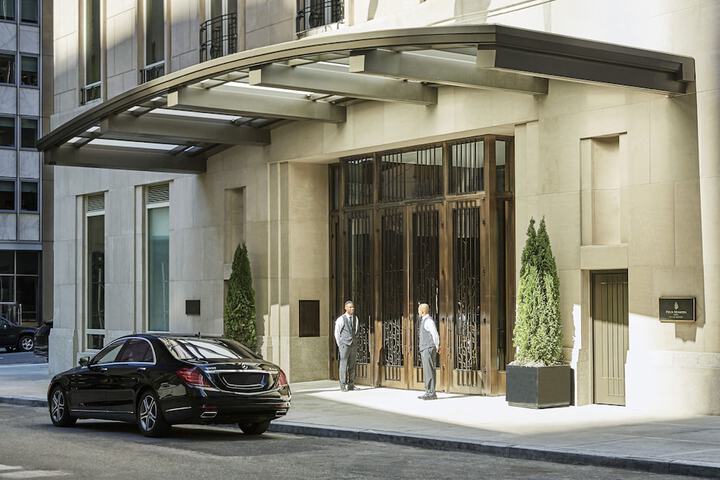
Four Seasons Hotel New York Downtown — Designed by Robert A.M. Stern with 189 rooms at 30 Park Place, right where Tribeca meets FiDi. The 75-foot lap pool, seven-room spa, and Cut by Wolfgang Puck make this feel like a destination, not a business hotel. The building also houses the Four Seasons Private Residences above the hotel floors — so your weekend stay doubles as a preview of what it’s like to live in the neighborhood’s most prestigious address.
Casa Cipriani New York — Forty-seven rooms in the restored 1909 Battery Maritime Building, a Beaux-Arts ferry terminal at the southern tip of Manhattan. Suites have terraces overlooking the Statue of Liberty, the Brooklyn Bridge, and the East River. The members’ club includes a jazz club, rooftop, and the full Cipriani dining experience. It’s the most exclusive hotel address in downtown Manhattan, and staying here makes the case for FiDi living better than any listing description could.
Schools & Family Life
FiDi has become a genuine family neighborhood — a shift that would have been unthinkable 20 years ago. The new residential buildings brought young families, and the infrastructure followed: playgrounds in Battery Park, the esplanade for bikes and strollers, and schools that outperform district averages.
Public schools: P.S. 234 Independence School is the standout — rated 5 stars on SchoolDigger with 82% reading proficiency and 77% math proficiency, consistently outperforming district and state averages. P.S./I.S. 276 Battery Park City School is another strong option for families in the western part of FiDi.
Private schools: The neighborhood is within reach of several well-regarded private schools in Tribeca and Lower Manhattan. For families buying remotely as international buyers, FiDi’s condo-heavy market (no co-op board approvals) makes the purchasing process significantly smoother than in more established family neighborhoods.
Family amenities: Battery Park City’s playgrounds, Pier 25 (the longest public pier in Manhattan, with mini golf, beach volleyball, and a skatepark), and the waterfront esplanade that stretches from the Battery to Chambers Street and beyond.
History & Architecture
The Financial District is where New York City began. The Dutch established New Amsterdam at the southern tip of Manhattan in 1626. Wall Street takes its name from a literal wall — a wooden barricade built in 1653 to defend the settlement’s northern boundary. By the late 18th century, the area was the nation’s financial center, and by the early 20th century, it was producing the most ambitious architecture on earth.
The architectural range is extraordinary. Federal Hall (1842, Greek Revival) on Wall Street is where George Washington took the oath of office. One Wall Street (1931, Art Deco) features Hildreth Meiere’s luminous red and gold mosaic that stretches across the former Irving Trust banking hall — now the lobby of a luxury condo. 40 Wall Street (1930, Art Deco) was briefly the world’s tallest building. The Woolworth Building (1913, Neo-Gothic) is still one of the most beautiful skyscrapers ever built — Cass Gilbert’s “Cathedral of Commerce” — and its top floors have been converted into some of Manhattan’s most exclusive residences.
Modern additions include One World Trade Center (2014, 1,776 feet), The Oculus by Santiago Calatrava (a transit hub that looks like a dinosaur skeleton made of light), and 130 William by David Adjaye (2020). The layering of centuries is visible on every block — a Georgian church next to a Beaux-Arts bank next to a glass-and-steel tower. It’s a living architectural museum.
Parks & Outdoor Spaces
Battery Park at the southern tip is FiDi’s anchor green space — 25 acres of gardens, monuments, and waterfront promenades with views of the Statue of Liberty and Ellis Island. The park is where you take morning runs, walk the dog, and catch the Staten Island Ferry (free, and one of the best views in the city).
Battery Park City Esplanade runs along the Hudson River for over a mile, connecting a series of parks, playgrounds, community gardens, and public art installations. It’s flat, car-free, and one of the most pleasant running and cycling routes in Manhattan. Pier 25 at the northern end has a beach volleyball court, mini golf, and a seasonal water park for kids.
The Elevated Acre — a semi-hidden public park on the roof of 55 Water Street — is FiDi’s best-kept secret. One acre of landscaped garden 40 feet above street level, with lawn chairs, an amphitheater, and sweeping views of the Brooklyn Bridge and East River. Almost nobody knows about it.
Zuccotti Park on Liberty Street and Bowling Green (the city’s oldest public park, established 1733) are smaller but useful neighborhood parks for a bench-and-coffee break during the day.
Getting Around
FiDi has the densest subway coverage in Manhattan. You are never more than a three-minute walk from a station, and the convergence of lines means you can reach virtually anywhere in the city in under 25 minutes.
The major hubs: Fulton Center (A, C, J, Z, 2, 3, 4, 5) is the nexus — a modern transit center connecting six subway lines under a striking glass dome. Wall Street stations serve the 2, 3, 4, and 5 lines. World Trade Center/Chambers Street gives you the E train, plus the PATH to New Jersey. Bowling Green (4, 5) and Whitehall Street–South Ferry (R, W, 1) cover the southern tip.
The PATH train from the WTC hub connects FiDi to Hoboken and Jersey City in under 10 minutes — useful if your partner works across the river. The NYC Ferry from Pier 11/Wall Street runs to Brooklyn (DUMBO, Williamsburg), Governors Island, and the Rockaways. Blade’s Downtown Manhattan Heliport is at Pier 6.
Parking is available but not cheap — $400–$600 per month. Several new-construction buildings (One Wall Street, 130 William) offer private garage access.
Key transit stops in the Financial District. Subway lines: 1, 2, 3, 4, 5, A, C, E, J, Z, N, R, W + PATH.
Is the Financial District Right for You?
You’ll love it if: You want the most apartment for your money in lower Manhattan. You value new-construction finishes, building amenities (pools, gyms, private dining, screening rooms), and transit access above all else. You appreciate dramatic architecture — living in a converted Art Deco tower or a David Adjaye building is not something you can replicate in the Village or Tribeca. You work in finance, tech, or anything downtown and want to eliminate your commute entirely.
You might want to look elsewhere if: You need the warmth and walkability of a classic residential neighborhood. FiDi is improving fast, but the street-level experience — especially on weekends and after dark — is still thinner than Tribeca, the Village, or the Upper West Side. The grid is confusing, the streets are narrow, and some blocks can feel empty. If you want brownstones, tree-lined streets, and corner bistros, consider Greenwich Village or the Upper East Side.
FiDi is for the person who sees opportunity in transformation. The neighborhood is still becoming what it’s going to be, and buying now means buying the trajectory. If that excites you, we should talk.
Frequently Asked Questions
Is the Financial District a good place to live?
Yes — increasingly so. FiDi has undergone a dramatic transformation from a weekday-only business district to a thriving residential neighborhood. New condo conversions offer some of the best amenity packages in Manhattan, transit access is unmatched, and prices per square foot are 20–30% below comparable neighborhoods like Tribeca and the West Village. The trade-off is a less established street-level retail and dining scene, though that’s changing rapidly.
What is the average apartment price in the Financial District?
The median sale price is approximately $1.3M as of early 2026, up 28.1% year-over-year. Condos average $1.2M, while studios start around $550K and three-bedrooms range from $2.5M to $8M. Price per square foot averages $1,200 — significantly below Tribeca, SoHo, or the Village.
Is the Financial District safe?
FiDi is very safe. The 1st Precinct (covering FiDi and Tribeca) consistently reports some of the lowest crime rates in Manhattan. The heavy security infrastructure from the World Trade Center area, combined with high foot traffic from office workers and tourists during the day, contributes to a strong safety profile. Evenings are quieter but well-lit and patrolled.
What subway lines serve the Financial District?
FiDi has the densest subway coverage in Manhattan. The A, C, J, Z, 2, 3, 4, 5 lines meet at Fulton Center. The 1, N, R, W serve Cortlandt/South Ferry. The E and PATH trains operate from the WTC hub. You are never more than a 3-minute walk from a station.
Wondering If We’re the Right Fit?
Every client and agent relationship starts with chemistry. Take our quick compatibility quiz to see if we’re the right team for your search.
Take the Quizor email me at anthony.park@corcoran.com