
The Upper West Side: Where New York Exhales
The Upper West Side runs from 59th Street at Columbus Circle to 110th Street at Cathedral Parkway, bounded by Central Park to the east and the Hudson River to the west. It’s the rare Manhattan neighborhood where you can walk three blocks in any direction and hit a park, a world-class cultural institution, or a prewar lobby that makes you stop and look up.
This is not a neighborhood that tries. The energy here is earned — decades of artists, writers, academics, and old-money families layering the streets with a character you can’t fabricate. Broadway hums with neighborhood restaurants and bookshops. Central Park West is a wall of Art Deco towers. Riverside Drive has the kind of quiet grandeur that stops conversations.
Clients reactions are almost always the same: it feels like home. Not in the aspirational sense — in the literal one. The streets are tree-lined, the sidewalks are wide, and nobody is performing. People live here because they chose substance over scene. Swing by for Halloween and you won’t believe how many kids are running around.
She’s a 52-year-old literary agent who earns $800K and doesn’t post about it. She owns a three-bedroom co-op in a prewar building on West 80th that she bought before the last boom, and she’ll never leave. Morning run in Riverside Park. Zabar’s on Saturday for smoked salmon and a loaf of sourdough that costs more than it should. She has season tickets at Lincoln Center and actually goes. She did Equinox at the Sports Club for six years before switching to a private Pilates studio on Amsterdam. She thinks Downtown is exhausting and Midtown is for work. She’s not wrong.
Upper West Side Real Estate: The Numbers
The Upper West Side remains one of Manhattan’s most active residential markets, with a buyer pool split between legacy co-op families who never leave and a new wave of condo buyers chasing modern finishes with Central Park views. The numbers reflect both.
Co-ops dominate the inventory here — roughly 70% of all sales — and they’ve been quietly outperforming. The median co-op price hit $1.2M, up 18.1% year-over-year, driven by a shortage of quality prewar units hitting the market. Condos sit at a $2.4M median, up 3.6% YoY, with new development at 200 Amsterdam and 50 West 66th Street absorbing the high-end demand.
| Property Type | Median Price | YoY Change | Avg $/SF |
|---|---|---|---|
| Condo | $2.4M | +3.6% | $2,100 |
| Co-op | $1.2M | +18.1% | $1,150 |
| Townhouse | $7.8M | +5.2% | $1,450 |
Rent vs. Buy: The Lifestyle Math
The average rent for a UWS apartment is $5,361/month. A two-bedroom in a good prewar doorman building runs $6,500–$8,500/month. Buying that same two-bedroom co-op will cost you roughly $1.8M–$2.5M, which at current rates puts your monthly carrying costs (mortgage, maintenance, taxes) in the $12,000–$16,000 range. The math favors renting in the short term, but the UWS co-op market has averaged 6–8% annual appreciation over the past three years, so the equity story catches up fast. If you plan to be here more than five years, buy. If you’re testing the neighborhood, rent a year first — the rent vs. buy math is always worth running for your specific situation.
Considering the Upper West Side?
Let’s talk about what’s available and what fits your lifestyle.
Where I’d Live
If I were buying on the Upper West Side today, these are the two buildings I’d be looking at. One is the tallest and most ambitious new tower in the neighborhood. The other is the kind of riverfront development that redefines what UWS living can feel like.
50 West 66th Street
69 Stories | 127 Units | Snøhetta | ~$3,400–$5,900/SF | Condo
Easily the most modern and most luxurious building in the Upper West Side. It’s also the tallest at 775 feet and has an sbsurd amenity package: indoor and outdoor pools, basketball and pickleball courts, porte cochère with valet. Units start around $4.6M and the penthouses go well north of $50M. You won’t find comps or discounts because it’s in a leage of its own.

Waterline Square
3 Towers | 263 Condo Units | Richard Meier, KPF & Rafael Viñoly | ~$2,700/SF | Condo
Three towers by three starchitects sharing a 100,000-square-foot amenity club that includes a tennis court, lap pool, indoor soccer field, rock climbing wall, and golf simulator. The Hudson River views are unobstructed, and the whole complex feels like a private campus on the western edge of the UWS. You get all the bells and whistles of a new dev at a slightly lower price point.
Where to Eat
My favorite restaurant on the Upper West Side: Bad Roman. From the team behind Michelin-starred Don Angie (my favorite Italian restaurant in the city), Bad Roman sits on the third floor of the Deutsche Bank Center at Columbus Circle and delivers the kind of Italian food that makes you forget you’re in a mall. Yes, I was caught off guard by where it was located but don’t let that affect you. The lobster was my favorite, the meatballs you can probably skip, and you can’t go wrong with the pastas.

My go-to coffee spot: Sote Coffee Roasters. A husband-and-wife operation at 329 Amsterdam Avenue that opened in 2024 and immediately became the best cup on the UWS. They roast locally, the espresso is dialed in every morning, and the space is small enough that it feels like your neighborhood spot from day one. No pretension, just really good coffee.
Three restaurants worth knowing:
Per Se — Thomas Keller’s three-Michelin-star tasting menu at Columbus Circle. There’s nothing I can say about Per Se that hasn’t been said. Nine courses, Central Park views, and a level of precision that justifies every dollar. Still one of the great dining experiences in the world.
Sushi Kaito — My second-ever omakase, courtesy of a mentor, the simple 12-seat omakase counter and menu is what made me fall in love with Edomae omakase. Chef Kaito serves one of the most precise omakase experiences in the city, and the intimacy of the room makes it feel like you’re eating in someone’s home.
Jean-Georges — Two Michelin stars at 1 Central Park West. Jean-Georges Vongerichten’s flagship has been anchoring the southwest corner of the neighborhood for decades, and the tasting menu still holds up against anything Downtown. The Central Park views from the dining room don’t hurt. It’s a spot to take your mom.
Section 05Shopping & Nightlife
The UWS isn’t a shopping destination in the way SoHo or Madison Avenue are, and that’s part of its charm. What it has is curated and personal. Columbus Avenue between 66th and 86th has a mix of boutiques and well-edited chains — Club Monaco, Sephora, Patagonia — alongside neighborhood originals like Bocnyc, which sources globally for contemporary ready-to-wear, and Frank Stella, a menswear boutique that’s been tailoring for UWS men for over forty years.
For something grander, The Shops at Columbus Circle are right there — Whole Foods in the basement, luxury retail upstairs, and the kind of convenience that makes you forget Amazon exists.
Nightlife is understated by design. Scarlet Lounge in the low 80s serves cocktails at a level that rivals any hotel bar downtown. The Django at the Roxy Hotel is a cab ride away, but most UWS residents prefer the neighborhood wine bars — a glass of Barolo at Cotta on Amsterdam, or a late-night Negroni at the bar at Osteria Cotta. Nobody is going out to be seen. They’re going out to enjoy the evening.

The private screening rooms at the Lincoln Center Film Society, where members see films before anyone else. The Equinox Sports Club on the Upper West Side — the original Equinox, opened in 1991 — with its rooftop track, rock wall, and indoor lap pool. It’s not just a gym; it’s a campus. The New-York Historical Society’s members-only evening lectures, where the crowd is half Columbia professors, half Central Park West co-op boards. And the annual Zabar’s experience — a deli counter that’s been operating since 1934 and still draws lines around the block. It’s not luxury in the velvet-rope sense. It’s institutional in a way that only the UWS can be.
Where to Stay When You Visit
If you want to test the Upper West Side before buying, these are the two hotels that will give you the most honest preview of what daily life feels like here.
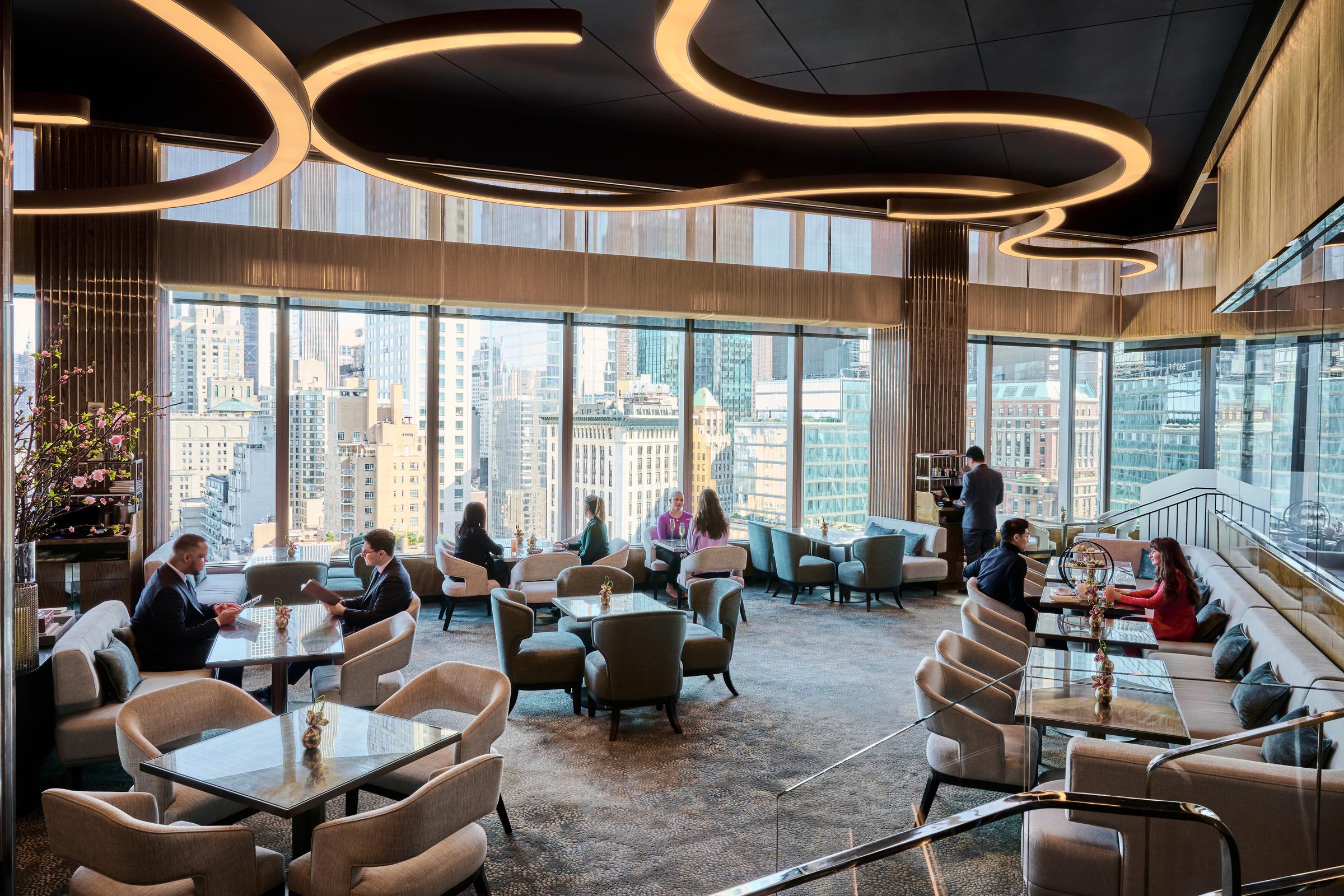
Mandarin Oriental, New York — Perched above Columbus Circle in the Deutsche Bank Center, the Mandarin Oriental is the UWS’s definitive luxury hotel. Just named one of the best hotels in the U.S. for 2026. The 14,500-square-foot spa operates one of only two Forbes Five-Star spas in Manhattan. The 75-foot indoor pool, the Central Park views from every room, and the MO Lounge for morning coffee make this the obvious choice. Stay here for a long weekend and you’ll understand why people pay $3,000/SF to live in this corner of the city.
Park Hyatt New York — At 153 West 57th Street, just south of Columbus Circle in the base of One57. Technically Midtown, but a five-minute walk to the UWS border and worth including because nothing else nearby matches it. The rooms are enormous by NYC standards, the spa is one of the best in the city, and the Living Room bar on the second floor has the kind of quiet sophistication that UWS buyers gravitate toward. Stay here if you want to experience the Columbus Circle gateway to the neighborhood without the noise of Times Square.
Section 07Schools & Family Life
The Upper West Side is one of the best family neighborhoods in Manhattan, full stop. The combination of two major parks, excellent schools, and a residential pace of life that actually lets kids be kids is hard to match anywhere else in the city.
Private schools on the UWS are among the best in the country. Trinity School (139 W 91st Street) was named the 23rd best private school in the U.S. and 5th in NYC, with a student-teacher ratio of 6:1 and tuition around $64,000. Collegiate School, the oldest school in the U.S. (founded 1628), ranks among the top in New York City. Calhoun School and Columbia Grammar & Preparatory School round out a private school landscape that rivals the Upper East Side.
Public schools are strong in the UWS zones. P.S. 87 (William Sherman) consistently ranks among the top public elementary schools in Manhattan. P.S. 199 (Jessie Isador Straus) and P.S. 166 (The Richard Rodgers School of the Arts & Technology) are both highly rated.
Beyond schools, the family cost equation here is straightforward: Central Park is your backyard, Riverside Park is your second backyard, the American Museum of Natural History is your rainy-day plan, and there’s a children’s bookstore (Book Culture) within walking distance of almost everything. For families who want their children to grow up in the city without it feeling like the city, this is the neighborhood.
Section 08History & Architecture
The Upper West Side is a living museum of New York residential architecture, and walking Central Park West or Riverside Drive is the fastest way to understand why people develop emotional attachments to buildings.
The neighborhood’s boom began with the opening of the Ninth Avenue Elevated in 1879, which triggered a wave of speculative development that produced the area’s signature Beaux-Arts townhouses and grand apartment buildings. The cohesiveness of the streetscape — limestone facades, English basements, exuberant ornamentation — comes from restrictive covenants that required “buildings of suitable character” and high-quality materials.
The Dakota (1 West 72nd Street, 1884) is the most famous residential building in New York, built in the North German Renaissance style with brick, sandstone, and terracotta panels. The Ansonia (2109 Broadway, 1904) is Beaux-Arts at its most theatrical — round-corner towers, the widest hallways in the city, and the distinction of being New York’s first air-conditioned hotel before its conversion to condos. The Apthorp (2211 Broadway, 1908) was the largest apartment building in the city when it was built, organized around a cobblestoned courtyard that still stops foot traffic.
Then came the Art Deco era of the late 1920s and early ’30s, which gave Central Park West its iconic skyline: The San Remo (1930, Emery Roth) with its twin towers — the first twin-towered residential building in the city. The Eldorado, The Majestic, and The Century, all completed in 1931, form a wall of Art Deco grandeur that defines the western edge of the park. Together with the San Remo, they constitute one of the most recognizable skylines in residential real estate.
The Upper West Side/Central Park West Historic District, with over 2,020 buildings, is one of the two largest historic districts in New York City — a designation won through decades of community advocacy under LANDMARK WEST!
Section 09Parks & Outdoor Spaces
No neighborhood in Manhattan has two parks like these. Central Park to the east, Riverside Park to the west — and you can cross the entire neighborhood on foot in ten minutes, which means residents use both daily.
Central Park needs no introduction, but the UWS sections are worth knowing. The Reservoir (officially the Jacqueline Kennedy Onassis Reservoir) is the morning run for most of the neighborhood — a 1.58-mile loop with views of the skyline in every direction. The Great Lawn, Belvedere Castle, and the Delacorte Theater (home of Shakespeare in the Park) are all in the UWS quadrant.
Riverside Park is the one outsiders don’t know about, and it’s arguably the better daily park. Designed by Frederick Law Olmsted and running four miles along the Hudson River from 59th to 155th Street, it has a waterfront promenade, tennis courts, a skate park, playgrounds, community gardens, and the 79th Street Boat Basin — one of the only places in Manhattan where you can live on a houseboat. Morning dog walks happen on the Riverside promenade. Weekend picnics happen on the lawns above the highway. It’s quieter, less crowded, and more personal than Central Park.
Theodore Roosevelt Park surrounds the American Museum of Natural History, and it’s a surprisingly peaceful pocket between Columbus Avenue and Central Park West. There’s also Riverside Park South below 72nd Street, a newer section with a manicured waterfront that connects to Hudson River Park’s bike path.
Section 10Getting Around
The Upper West Side has some of the best subway access in Manhattan, with two north-south lines covering the neighborhood’s full length.
The 1, 2, 3 trains run along Broadway with stops at 59th–Columbus Circle, 66th–Lincoln Center, 72nd, 79th, 86th, 96th, and 103rd Streets. The express 2/3 at 72nd and 96th will get you to Midtown in under 10 minutes and to the Financial District in 25.
The B and C trains run along Central Park West with stops at 72nd, 81st (Museum of Natural History), 86th, 96th, 103rd, and Cathedral Parkway–110th. The B is an express that connects to Midtown’s 6th Avenue corridor (Rockefeller Center, Bryant Park).
At Columbus Circle, you also pick up the A and D trains, giving you direct express access to JFK (via the A to Howard Beach) and LaGuardia (via the M60 bus connection at 125th).
For this audience: Blade operates from the West 30th Street Heliport (15 minutes by car from the mid-UWS) with regular service to JFK, the Hamptons, and Nantucket. Private car services stage from the hotels at Columbus Circle. Garage availability is decent by Manhattan standards — several buildings on the avenues have private garages, and there are public lots on every major cross street.
Key transit stops on the Upper West Side. Subway lines: 1, 2, 3, A, B, C, D.
Is the Upper West Side Right for You?
The Upper West Side is the right neighborhood if you want substance over spectacle. Here’s the honest breakdown.
It’s right for you if:
You value space and greenery. Double-park access (Central Park and Riverside Park) is unmatched in Manhattan. If morning runs, dog walks, and weekend picnics are part of your life, this is the best-positioned neighborhood in the city.
You’re raising a family. The schools — both private and public — are excellent. The streets are residential and quiet enough that your kids can grow up with independence. The AMNH is your rainy-day backup plan.
You want culture without trying. Lincoln Center is right there. The Met Opera, the Philharmonic, NYC Ballet, Film at Lincoln Center — these aren’t excursions, they’re Tuesday night plans.
You prefer prewar character. If your ideal apartment has high ceilings, original moldings, and a lobby that smells like history, the UWS co-op market is one of the deepest in the city.
Look elsewhere if:
You want a dining scene. The UWS has Per Se, Tatiana, and a handful of excellent spots, but it’s not the West Village or Lower East Side. The restaurant density is thinner, and the neighborhood doesn’t turn over new openings the way Downtown does.
You want nightlife. This is not a going-out neighborhood. If your ideal Saturday night involves bar-hopping and DJ sets, the UWS will bore you by 10pm.
You need modern finishes without compromise. Most UWS inventory is prewar co-ops. The new developments (200 Amsterdam, 50 West 66th) are excellent but limited. If you need floor-to-ceiling glass and smart-home everything, you’ll have fewer options than in Hudson Yards or the Midtown East new builds.
The Upper West Side is for the buyer who’s done proving things. You already know what you want — space, quality, and a neighborhood that doesn’t need to reinvent itself every two years. If that resonates, call me. I’ve sold on every block between 60th and 100th, and I’ll tell you exactly which ones are worth your money.
Frequently Asked Questions
Is the Upper West Side a good place to live?
The Upper West Side is consistently ranked among the most livable neighborhoods in Manhattan. It offers a rare combination of two major parks (Central Park and Riverside Park), world-class cultural institutions (Lincoln Center, the American Museum of Natural History), excellent public and private schools, and a residential atmosphere that feels remarkably calm for a neighborhood in the center of Manhattan. For families, professionals, and anyone who values quality of life over nightlife, it’s one of the best choices in the city.
What is the average apartment price on the Upper West Side?
As of early 2026, the median sale price on the Upper West Side is $1.4 million, up 8.6% year-over-year. Co-ops average around $1.2 million and condos around $2.4 million. The median price per square foot is approximately $1,570. Prices vary significantly by block and building — a prewar co-op on a side street might sell for $1,100/SF, while a new condo on Central Park West can exceed $3,000/SF.
What subway lines serve the Upper West Side?
The Upper West Side is served by the 1, 2, 3 trains along Broadway and the B, C trains along Central Park West. At Columbus Circle (59th Street), you can also access the A and D trains. The express 2/3 from 72nd Street reaches Times Square in 8 minutes and Wall Street in 22 minutes.
Is the Upper West Side safe?
The Upper West Side is one of the safest neighborhoods in Manhattan, with crime rates well below the citywide average. The 20th Precinct (59th–86th Streets) and 24th Precinct (86th–110th Streets) both report low rates of violent crime. The residential character, active street life, and strong community presence contribute to a neighborhood that feels secure at all hours. Like any Manhattan neighborhood, standard urban awareness applies, but the UWS is a place where families walk home from Lincoln Center at 11pm without thinking twice.
Upper West Side vs. Upper East Side: which is better?
They’re different neighborhoods for different people. The Upper East Side skews more formal, with Madison Avenue shopping and a heavier concentration of old-money co-ops. The Upper West Side is more relaxed, more intellectual, and more family-oriented. The UWS has better park access (Riverside Park is a genuine advantage), better subway coverage, and a more diverse dining and cultural scene. The UES has stronger luxury retail and slightly higher price points at the top end. I work in both and recommend them based on lifestyle, not status — read my Midtown guide for a third option.
Wondering If We’re the Right Fit?
Every client and agent relationship starts with chemistry. Take our quick compatibility quiz to see if we’re the right team for your search.
Take the Quizor email me at anthony.park@corcoran.com