
The Triangle Below Canal
Tribeca is the neighborhood people move to when they’ve made it and don’t need anyone to know. Bounded by Canal Street to the north, West Street along the Hudson, Broadway to the east, and Vesey Street to the south, it’s a 40-block stretch of converted warehouses, cobblestone side streets, and some of the most expensive residential real estate in the Western Hemisphere.
Walk down Greenwich Street on a Tuesday morning and you’ll pass Ryan Reynolds walking his kids to school, a finance partner stepping out of a black car, and a gallery owner unlocking a cast-iron storefront. Nobody looks twice. That’s the entire point.
The energy here is deliberately quiet. There are no neon signs, no tourist traps, no rooftop bars blasting house music. Tribeca’s nightlife is a wine bar with twelve seats. Its retail is a Shinola flagship designed by David Rockwell. Its idea of a scene is a Michelin three-star restaurant on a corner that looks like it could be a dry cleaner from the outside.
Late forties, household income north of $1.5M. Probably in finance or runs something — a fund, a production company, a brand you’ve heard of. Wears Common Projects and a Loro Piana jacket, not because they’re making a statement but because they stopped thinking about what to wear a decade ago. Weekend routine: Equinox at 7, coffee at Gotan by 8:30, farmers market at Greenwich and Chambers, then brunch at Locanda Verde where the host knows them by name. Has a house in Amagansett but will never call it “the Hamptons.” Chose Tribeca over the Upper East Side because they wanted their kids to grow up around cobblestone, not doormen in white gloves. Doesn’t post on Instagram. Doesn’t need to.
Tribeca Real Estate: The Numbers
Tribeca consistently ranks as one of Manhattan’s most expensive neighborhoods, and the numbers tell you why. This isn’t a market driven by speculation — it’s driven by people who want to live here and have the means to outbid everyone else. Understanding what you’re walking into before you make an offer is critical, and having the right attorney reviewing your deal is non-negotiable at these price points.
The median sale price sits around $3.8 million as of late 2025, with well-priced properties moving in about 53 days. That said, trophy units in buildings like 56 Leonard or 67 Vestry trade in a different universe — $15M+ deals that close in weeks, often all-cash. The co-op market, meanwhile, has softened: median co-op prices dropped roughly 34% year-over-year to $2.8M, largely because buyers at this level overwhelmingly prefer the flexibility of condos.
The condo market tells the real Tribeca story. Median condo prices hover around $3.9M, and price per square foot regularly exceeds $2,500 for new development. At the top end, you’re looking at $3,000+ per foot — numbers that rival the most expensive corridors on the planet.
| Property Type | Median Price | YoY Change | Avg $/SF |
|---|---|---|---|
| Condo | $3.9M | +2% | $2,750 |
| Co-op | $2.8M | -34% | $1,600 |
| Townhouse | $8.5M+ | Limited data | $2,200 |
Rent vs. Buy: The Lifestyle Math
A two-bedroom rental in Tribeca averages around $8,500/month, though the range is enormous — a renovated loft on Duane Street might run $12,000, while a walkup on Church could be closer to $6,500. If you’re buying a $3.5M two-bedroom condo with 20% down, your all-in monthly cost (mortgage, taxes, common charges) lands around $18,000-$20,000.
On the flip side, if you buy and rent it out, a two-bedroom in a full-service building can command $10,000-$14,000/month depending on finishes and views. The math won’t cash-flow day one, but Tribeca appreciates. People who bought in 56 Leonard at launch are sitting on 40%+ gains. Make sure you understand what’s in your contract before you sign.
Considering Tribeca?
Let’s talk about what’s available and what fits your lifestyle.
Where I’d Live
If I were buying in Tribeca tomorrow, I’d be looking at two buildings. One is the kind of place you tell people about; the other is the kind of place you keep to yourself.

56 Leonard Street
145 units · 60 stories · Herzog & de Meuron · Full-service condo
The “Jenga Tower” — Pritzker Prize-winning Herzog & de Meuron designed every floor to be different, with cantilevered volumes stacked like a vertical sculpture. An Anish Kapoor mirrored bean anchors the base. Every one of 145 residences has private outdoor space, 11–14-foot ceilings, and floor-to-ceiling glass. 75-foot infinity pool, screening room, private parking. Resales averaging ~$3,200/SF. It changed the Tribeca skyline — and the building hasn’t lost a step since 2016.

67 Vestry Street
13 units · 12 stories · Gachot Studios / BP Architects · Condo
The last of Tribeca’s historic waterfront properties — an 1896 Romanesque Revival warehouse converted into just 13 residences by Gachot Studios (AD 100 list). Frederick Dinkelberg designed the original building — the same architect behind the Flatiron Building. Light oak floors, understated millwork, and unobstructed Hudson River views from every unit. 50-foot lap pool in a double-height cedar-and-bluestone room. Three- to six-bedroom layouts. If 56 Leonard is the building you show off, 67 Vestry is the one you keep to yourself.
Where to Eat
My favorite restaurant in Tribeca: Jungsik. Three Michelin stars. The first Korean restaurant in the U.S. to earn that distinction, and it sits on a quiet corner of Harrison and Hudson in the old Chanterelle space. Chef Jungsik Yim’s tasting menu fuses Korean flavors with French precision — the kind of meal where each course resets what you thought the cuisine could be. This is where I take clients to celebrate a closing.

My go-to coffee spot: Gotan. A Counter Culture partnership since 2014, and the kind of neighborhood place where you see the same ten people every morning. Good light, good coffee, no pretension. It’s my 8:30 stop before showings downtown.
Three restaurants worth knowing:
L’Abeille — Chef Mitsunobu Nagae’s 48-seat French-Japanese tasting menu on the corner of Greenwich and Laight. Michelin-starred. Nagae trained at three-star Joël Robuchon restaurants in Tokyo and Paris, and the precision shows — foie gras crème brûlée, miso-marinated butterfish, and courses that look like they belong in a gallery. Velvet chairs, Christofle cutlery, marble bar. Tuesdays through Saturdays. 412 Greenwich Street.
Icca — Chef Kazushige Suzuki’s one-star omakase counter on Warren Street. Earned its star within a year of opening. The front bar does an Italian kappo concept; the back counter is 16 seats of some of the best sushi downtown. Fish flown direct from Japan.
Muku — Ten seats, kaiseki-inspired, and the fastest Michelin star in NYC history — earned just two months after opening in late 2025. The $295 tasting menu applies the Japanese rule of five cooking techniques with meticulous seasonal precision. Book a month out on Tock.
Section 05Shopping & Nightlife
Tribeca shopping isn’t a shopping district — it’s a series of deliberate, widely-spaced stores that cater to people who already know what they want. Shinola’s Tribeca outpost — designed by David Rockwell — carries handcrafted watches, leather goods, and bicycles in a space that feels more like a members club than a retail store. Nili Lotan on Duane Street is the neighborhood’s own — she lives in Tribeca and designs for the women who live here. James Perse on Hudson carries the effortless California staples that half the neighborhood wears on weekends.
Jenni Kayne on Greenwich offers the California-meets-downtown wardrobe that half the neighborhood already wears. For home design, Roman and Williams Guild on Howard Street is the showroom-as-experience concept from the firm behind The Dutch and Le Coucou — ceramics, furniture, rare books, and a café by La Mercerie all under one roof.
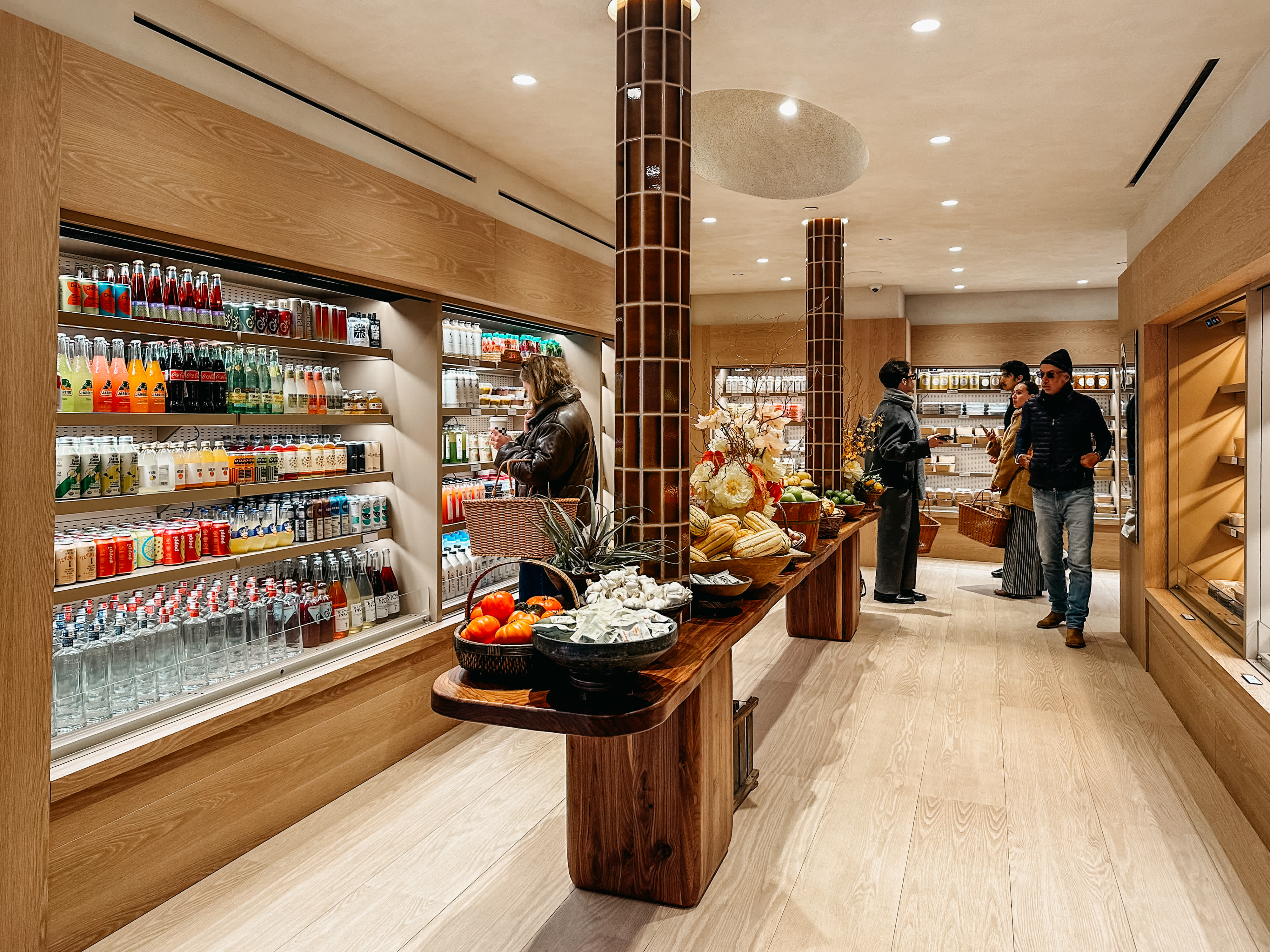
Nightlife in Tribeca is quiet by design but they made some noise with the introduction of Meadow Lane — a gourmet market and prepared foods emporium with some of the heftiest price tags. The Roxy Hotel on Sixth Avenue is the closest thing to a scene — live jazz in the lobby lounge, a cinema club downstairs, and a cocktail bar that draws a well-dressed crowd without ever feeling hectic. WarrenPeace on Warren Street is the kind of neighborhood bar-restaurant where the music is curated, the lighting is dim, and the duck-fat fries are reason enough to stay. Low-key and homey, with leather menus and no TVs. Walker’s on Varick has been pouring since 1890 and remains the rare Tribeca institution that hasn’t been renovated into oblivion.
Tribeca is the only neighborhood in Manhattan where your weekly errands include a caviar shop. Marky's Caviar opened on Greenwich and Duane in late 2024 — a boutique stocked with Private Stock tins from their own Florida sturgeon farm, mother-of-pearl spoons, and Beluga you won't find anywhere else in the city. Behind the retail front sits Huso, Chef Buddha Lo's Michelin-starred tasting menu. You walk through a caviar shop to get to your dinner reservation. That's Tribeca in one sentence.
A block south, Meadow Lane landed at 355 Greenwich and immediately drew lines around the block. It's a gourmet grocer built like an Apple Store — custom Italian cabinetry, rotating art curated by Creative Art Partners, a floral studio, and a prepared foods counter run by a Michelin-starred chef. The TikTok hype will fade. The neighborhood will keep it.
Where to Stay When You Visit
If you’re thinking about buying in Tribeca, spend a weekend here first. Not a day trip — a weekend. Walk the streets at 7 AM and again at 11 PM. Eat at the restaurants. Stand on the corner of Greenwich and Harrison and see if the silence feels like peace or loneliness. These two hotels let you test-drive the neighborhood properly.

The Greenwich Hotel — Robert De Niro’s 88-room hotel on Greenwich Street, where no two rooms are the same. Hand-loomed Tibetan silk rugs, Moroccan tile, reclaimed wood details. The Shibui Spa in the basement features a pool inside a 250-year-old Japanese farmhouse reconstructed nail-free by craftsmen from Kyoto. Locanda Verde, the Italian restaurant on the ground floor, is where half the neighborhood eats on any given Tuesday. Stay here and you’ll feel like a resident, not a guest.
Four Seasons Hotel New York Downtown — The more polished option. Twenty-four floors in a tower adjacent to the Financial District, with Wolfgang Puck’s CUT on the ground floor, an indoor lap pool, and a full-service spa. The recently unveiled Greenwich Collection suites feature full kitchens — designed for guests who want the feel of a Tribeca apartment with five-star service. If you’re comparing Tribeca to other neighborhoods, this gives you the most neutral base camp.
Section 07Schools & Family Life
Tribeca might be the best family neighborhood in Manhattan that nobody outside the city ever talks about. The streets are wide and quiet, there’s a playground seemingly every three blocks, and the school options — both public and private — are genuinely strong.
PS 234 on Greenwich is the public school everyone fights for — known for progressive teaching and a community of parents who are intensely involved. PS 150 carries a 10/10 GreatSchools rating with 88% math proficiency and 85% reading proficiency. For private, Léman Manhattan Preparatory School is an IB World School right in the neighborhood (A+ on Niche), and Battery Park Montessori serves families in the southern reaches.
For older kids, Stuyvesant High School is a 15-minute walk — one of the most competitive specialized public high schools in the country. The family infrastructure is real: stroller-friendly sidewalks, a Whole Foods at Chambers, a Target at Greenwich and Warren, and enough neighborhood restaurants with high chairs that you won’t feel exiled from adult dining.
Section 08History & Architecture
Tribeca — the Triangle Below Canal Street — was named in the 1970s by a real estate agent trying to brand a derelict warehouse district. It worked. Before the name, this was the city’s commercial spine: textile merchants, shipping companies, and produce markets operating out of cast-iron and brick buildings designed between the 1850s and 1880s.
What they left behind is the largest collection of cast-iron facades in the world, rivaled only by neighboring SoHo. These buildings — with their ornate cornices, arched windows, and decorative columns — were originally fire-resistant warehouses. The cast-iron elements were prefabricated and bolted into place, eliminating the need for stone carvers. Function created the beauty by accident.
Cast Iron House at 67 Franklin Street is a landmark example — built in 1881-82 in the Italianate style, it’s on the National Register of Historic Places. Shigeru Ban’s conversion transformed it into luxury condominiums while preserving the original facade. The Grosvenor Building at 64 White Street (1869) still shows its original cast-iron columns and whitewashed brick.
Then there’s the modern layer. 56 Leonard Street — the “Jenga Tower” by Herzog & de Meuron — rises 56 stories of cantilevered glass volumes that look like they shouldn’t stand up but do. Anish Kapoor’s sculpture at its base has become a neighborhood landmark. It’s the rare contemporary building that’s earned the right to stand next to 150 years of architecture.
Section 09Parks & Outdoor Spaces
Tribeca’s western edge is defined by Hudson River Park, the 550-acre riverfront park that runs four miles along Manhattan’s west side. The Tribeca section — roughly from Chambers to Canal — is one of the park’s best stretches.
Pier 25 is the anchor: sand volleyball courts, mini-golf, a multi-purpose sports field, children’s play areas, and a sunset deck that faces New Jersey in a way that actually looks beautiful at golden hour. Pier 26 added a 4,000-square-foot Science Playground and native habitat area, plus a public boathouse for kayaking.
The Tribeca Native Boardwalk is the quieter find — a meandering path through indigenous Eastern red cedars, switchgrass, and goldenrod, elevated ten feet above the Hudson. It feels like the High Line’s more understated cousin, and on a weekday afternoon you might have it entirely to yourself.
For morning runs, the Hudson River Greenway is the best uninterrupted bike and running path in the city — you can go from the tip of Manhattan to the George Washington Bridge without stopping. The neighborhood also has Washington Market Park on Greenwich, a dog run on Pier 25, and basketball and tennis courts scattered along the waterfront.
Section 10Getting Around
Tribeca’s transit is solid without being spectacular. The 1 train runs through the neighborhood’s spine with stops at Franklin Street and Chambers Street, giving you a direct shot to Midtown in about 20 minutes. The A/C/E lines stop at Canal Street to the north and a second Chambers Street station to the south, connecting you to the west side, JFK (via the A), and Midtown’s office corridors.
The 2/3 express at Park Place gets you to Midtown in 12 minutes flat. For the Financial District, you’re already there — most of FiDi is a 10-minute walk south.
Beyond the subway: the Downtown Manhattan Heliport is a five-minute drive for Blade flights to JFK, the Hamptons, or Atlantic City. Garage availability is better than almost any Manhattan neighborhood — 56 Leonard, 67 Vestry, and several other buildings offer private parking, and there are multiple commercial garages along West Street. The M20 bus runs along the waterfront, and Citi Bike stations dot every few blocks.
Key transit stops in Tribeca. Subway lines: 1, 2, 3, A, C, E.
Is Tribeca Right for You?
Tribeca is for the person who wants Manhattan at its most refined and least performative. You’re paying a premium — one of the highest in the city — for quiet, for space, for the privilege of living somewhere beautiful that doesn’t need to announce itself.
It’s right for you if: You value discretion over scene. You want your kids in strong schools with cobblestone streets to walk on. You eat well and don’t need a restaurant on every block to prove it. You want Hudson River views, waterfront parks, and a morning run that doesn’t involve dodging tourists. You’re buying a home, not making an investment thesis.
Look elsewhere if: You want nightlife that goes past midnight. You need the energy of a dense retail and restaurant corridor (try Chelsea or the West Village). You want a co-op with lower carrying costs. Or you simply don’t want to pay $2,750/foot for the privilege of cobblestone silence.
The trade-off is real: Tribeca gives you the most beautiful residential blocks in Manhattan, but it can feel isolated on a Sunday night in January. If that sounds like peace, welcome home. If it sounds like loneliness, keep looking. Either answer is honest.
If you’re seriously considering Tribeca, understand the contingencies that protect you in a deal at this price point. Then call me. I’ll walk you through what’s actually on the market and what’s coming.
Frequently Asked Questions
Is Tribeca a good place to live?
Tribeca is one of the best residential neighborhoods in Manhattan if you value quiet, architectural beauty, strong schools, and walkability. The trade-offs are cost (median sale price around $3.8M) and a nightlife scene that’s deliberately subdued. For families and professionals who want Manhattan without the noise, it’s hard to beat.
What is the average apartment price in Tribeca?
As of late 2025, the median sale price in Tribeca is approximately $3.8 million. Condos average around $3.9M (roughly $2,750/sq ft), while co-ops have dropped to about $2.8M median. Townhouses, when they trade, typically start at $8.5M and climb steeply.
What subway lines serve Tribeca?
The 1 train stops at Franklin Street and Chambers Street, running through the neighborhood’s center. The A, C, and E trains stop at Canal Street (northern edge) and Chambers Street (southern edge). The 2 and 3 express trains at Park Place provide a fast connection to Midtown in about 12 minutes.
Is Tribeca safe?
Tribeca is one of the safest neighborhoods in Manhattan, with some of the lowest crime rates in the borough. The combination of a residential population, well-lit streets, and relatively low foot traffic contributes to a feeling of security that’s unusual for downtown Manhattan.
Wondering If We’re the Right Fit?
Every client and agent relationship starts with chemistry. Take our quick compatibility quiz to see if we’re the right team for your search.
Take the Quizor email me at [email protected]